
Which site would you like to visit?
By clicking the retail or wholesale site button and/or using rarewineco.com you are choosing to accept our use of cookies to provide you the best possible web experience.


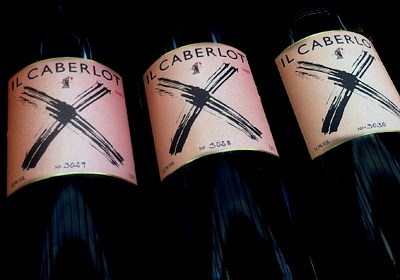
Until 2005, one Tuscan wine had existed in name only for American wine lovers. Bottled exclusively in magnum, only a handful of enotecas (out of a thousand or more) in Tuscany get any, and restaurant allocations are limited to the likes of Florence’s Il Cibreo, and Paris’ 3-star establishments.
Members of Florence's elite Teatro del Sale can buy one magnum per year, a privilege handed down from generation to generation. And, in 2005, we were fortunate to be named the estate’s first U.S. agent.
The wine is Il Caberlot, and its fascinating story doesn't end with its scarcity and desirability. It, and its second label Carnasciale, are the only wines in the world made from a mysterious clone discovered four decades ago near Verona. Named "Caberlot," the grape has characteristics of both Cabernet and Merlot—hence its name.
Caberlot's discoverer-agronomist Remigio Bordini- has allowed the vine to be planted just one place outside his nursery: at Wolf and Bettina Rogosky's Tuscan estate, Il Carnasciale. The vineyard lies atop a rocky, south-facing bluff that towers above Tuscany's Arno River. Famed enologist Vittorio Fiore discovered this providential site in 1986.
“Over the years Il Carnasciale has acquired cult status among readers who crave the finest Tuscany has to offer, and rightly so. These are some of the most unique wines from Italy.”
- Antonio Galloni
To limit yields, Fiore advised the Rogoskys to plant at a then-revolutionary 10,000 vines per hectare and to prune to a mere five clusters per plant. As if to presage Il Caberlots future, the Rogoskys buried a bottle of Sassicaia under the first vine.
From the first vintage, 1988, Il Caberlot has been a huge cult wine in Europe, its scarcity driven by nature and the vineyard’s size of less than an acre. Wolf Rogosky passed away in 1996, but Bettina has carried on the work with her son, Moritz, who today manages the project.
With time, more vines have been planted, but production remains minuscule. The wine is still bottled by hand and is held for two years before release.
Il Caberlot boasts an extraordinary perfume, sleek texture, and quiet elegance. Boasting nuances of Graves, Pomerol, and Il Carnasciale’s unique terroir, it ranks among the planet's most singular wines. And, with over 30 vintages since its debut, Il Caberlot has shown it can evolve in the cellar with astonishing grace.
In 2000, the estate introduced Carnasciale as a classic second wine. Sourced from younger vines and declassified fruit, it mirrors its sibling perfectly, and is often more precocious – a wine to drink while the Il Caberlot slumbers.
And, in 2016, Moritz and Bettina added an ethereal Sangiovese called Ottantadue. It highlights how the estate’s terroir contributes to all the wines’ elegance and refinement.
| Year | Description | Size | Notes | Avail/ Limit |
Price | |
|---|---|---|---|---|---|---|
 2018
2018
|
2018 Il Carnasciale Caberlot 1.5 L | 1.5 L |
JG96 Read Notes |
1 | $425.00 | add |
|
2020
|
2020 Il Carnasciale Caberlot (3-magnum OWC) 1.5 L | 1.5 L |
WS97 / AG94 |
2 | $899.00 | add |
|
2020
|
2020 Il Carnasciale Caberlot 1.5 L | 1.5 L |
WS97 / AG94 |
6 | $325.00 | add |
|
2018
|
2018 Il Carnasciale Caberlot Perelli Riserva 1.5 L | 1.5 L |
AG98 / JG97 |
2 | $475.00 | add |
|
2020
|
2020 Il Carnasciale Carnasciale |
AG92 / JG92+ / WA91 |
12 | $59.95 | add |
New discoveries, rare bottles of extraordinary provenance, limited time offers delivered to your inbox weekly. Be the first to know.
Please Wait
Adding to Cart.
...Loading...
By clicking the retail or wholesale site button and/or using rarewineco.com you are choosing to accept our use of cookies to provide you the best possible web experience.